Are all cryptocurrencies mined
If Bitcoin in 2140 essentially serves as a store of value rather than for daily purchases, then it’s still possible for miners to profit—even with low transaction volumes and the disappearance of block rewards https://realitypms.com/. Miners could charge high transaction fees to process high-value or large batches of transactions, with more efficient “layer 2” blockchains like the Lightning Network working with the Bitcoin blockchain to facilitate daily bitcoin spending.
“The challenge that comes with mining as a business is that you have the upfront cost of mining equipment plus the constant costs of electricity (for running the equipment 24/7), but you are only rewarded cryptocurrencies if you successfully outcompete others in puzzle solving,” said Benjamin Cole, a cryptocurrency expert and professor at Fordham University’s Gabelli School of Business.
“We imagine that several divisions of the Byzantine army are camped outside an enemy city, each division commanded by its own general. The generals can communicate with one another only by messenger. After observing the enemy, they must decide upon a common plan of action. However, some of the generals may be traitors, trying to prevent the loyal generals from reaching agreement. The generals must have an algorithm to guarantee that A. All loyal generals decide upon the same plan of action….[and> B. A small number of traitors cannot cause the loyal generals to adopt a bad plan.”
Transaction fees will become a primary source of income for miners, making up around 6% of a miner’s revenue currently, but expected to increase exponentially before Bitcoin’s network reaches its supply limit.
However, cryptocurrencies don’t have a central authority; rather, the cryptocurrency community and, in particular, cryptocurrency miners and network nodes manage them. For this reason, cryptocurrencies are often referred to as trustless. Because no single party or entity controls how a cryptocurrency is issued, spent, or balanced; you don’t have to put your trust in a single authority.
Are all cryptocurrencies the same
Financial tokens are digital assets that support economic activities such as lending, borrowing, trading, and yield generation within decentralised finance (DeFi) ecosystems. These tokens often represent access to specific financial services, act as incentives for participation, or enable protocol-level fee structures. Many of them are native to DeFi platforms and play a central role in shaping on-chain financial products.
Virtual currencies are unregulated digital currencies controlled by developers or a founding organization consisting of various stakeholders involved in the process. Virtual currencies can also be algorithmically controlled by a defined network protocol. An example of a virtual currency is a gaming network token whose economics is defined and controlled by developers.
The introduction of a U.S. CBDC presents certain difficulties. For instance, for Congress to authorize the issuance of a CBDC, there must be robust privacy and security infrastructures put in place. The government must also weigh the possible impacts on monetary policy and the operational management of the switch from conventional money to a CBDC.

Financial tokens are digital assets that support economic activities such as lending, borrowing, trading, and yield generation within decentralised finance (DeFi) ecosystems. These tokens often represent access to specific financial services, act as incentives for participation, or enable protocol-level fee structures. Many of them are native to DeFi platforms and play a central role in shaping on-chain financial products.
Virtual currencies are unregulated digital currencies controlled by developers or a founding organization consisting of various stakeholders involved in the process. Virtual currencies can also be algorithmically controlled by a defined network protocol. An example of a virtual currency is a gaming network token whose economics is defined and controlled by developers.
Do all cryptocurrencies use blockchain
Ethereum Request for Comment 20 (ERC-20) is the implemented standard for fungible tokens created using the Ethereum blockchain. ERC-20 guides the creation of new tokens on the Ethereum blockchain so that they are interchangeable with other smart contract tokens.
In contrast, in a traditional database, if someone makes a mistake, it may be more likely to go through. In addition, every asset is individually identified and tracked on the blockchain ledger, so there is no chance of double spending it (like a person overdrawing their bank account, thereby spending money twice).
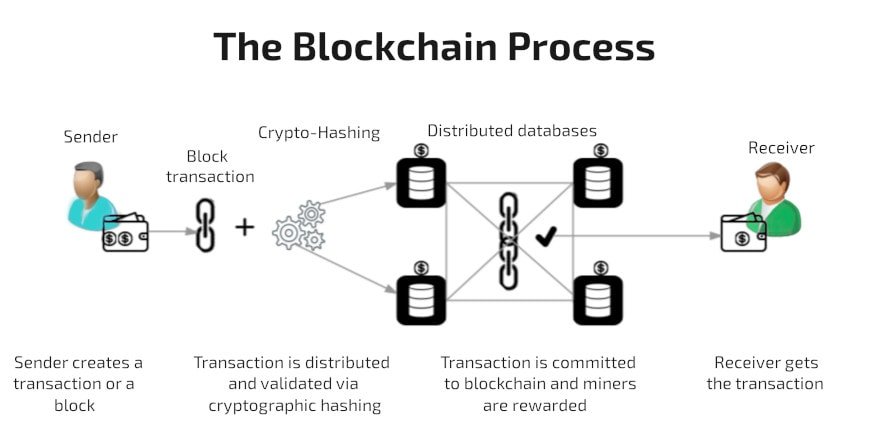
A blockchain consists of programs called scripts that conduct the tasks you usually would in a database: entering and accessing information, and saving and storing it somewhere. A blockchain is distributed, which means multiple copies are saved on many machines, and they must all match for it to be valid.
Ethereum Request for Comment 20 (ERC-20) is the implemented standard for fungible tokens created using the Ethereum blockchain. ERC-20 guides the creation of new tokens on the Ethereum blockchain so that they are interchangeable with other smart contract tokens.
In contrast, in a traditional database, if someone makes a mistake, it may be more likely to go through. In addition, every asset is individually identified and tracked on the blockchain ledger, so there is no chance of double spending it (like a person overdrawing their bank account, thereby spending money twice).
A blockchain consists of programs called scripts that conduct the tasks you usually would in a database: entering and accessing information, and saving and storing it somewhere. A blockchain is distributed, which means multiple copies are saved on many machines, and they must all match for it to be valid.